
What Is RF Welding And How Does RF Heat Sealing Work?
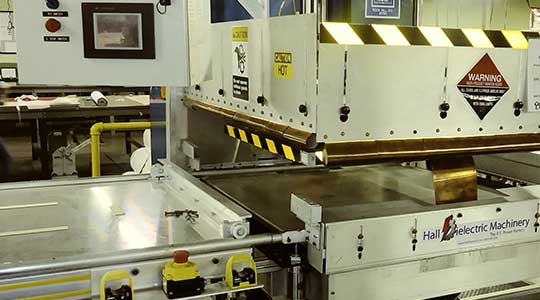
RF welding and RF heat sealing are often used interchangeably when people talk about the kind of industrial sewing we do at Vinyl Technology.
Although the result of RF welding often resembles the same airtight and waterproof barrier you get from a traditional heat seal, the technology requires no heat at all. Our RF sealing services, also known as dielectric stitching, use high-energy radio frequencies to bond plastic items together with an airtight, watertight seal.
Request a Quote Start a Project
A High-Tech Solution In RF Welding & RF Sealing Services
RF welding sounds a little strange the first time someone explains it. Radio waves are usually something we associate with signals, antennas, or old shop radios crackling in the corner. In this case, they help two compatible plastic materials become one sealed piece.
The process has been used for decades, and there’s a reason manufacturers still rely on it. An RF welding machine sends electromagnetic energy into the plastic where the seam needs to form. The material has to respond the right way under that energy. Vinyl does, which is why you see RF welding used so often for flexible products that need a dependable seal.
Inside the material, the molecules start moving under the radio frequency field. The machine also applies pressure at the seam. This combination creates the bond from within the material itself, rather than adding glue or punching holes with thread.
A finished RF weld can look simple from the outside. A clean line. A sealed edge. Maybe nothing too exciting to the eye. The value is in what the seam can handle after it leaves the table, especially on products that need to hold air or keep liquid where it belongs.
Why Is RF Welding Called Heat Sealing If It’s Not Hot?
Don’t be fooled by the name, even though it is technically correct: the bond formed by the radio-frequency field in RF welding is a kind of high-temperature seal, accomplished without a hot surface or heating element. This seal is created not by applying heat but by using electromagnetism to do so.
It’s similar to the difference between the convection oven you use for baking cookies and your microwave oven–two different technologies, two different uses, but the same result: a complete, nonpermeable seal through RF welding.
What Is RF Welding Used For?
Like most industrial sewing applications, the terms RF welding and RF heat sealing are broadly applicable to many scenarios unique to the use of heavy-duty fabrics in manufacturing. When an impenetrable bond is needed to unite two flexible materials, other methods of joining them can be less than ideal. A stitch, for example, is, by itself, rarely waterproof. Glue or other kinds of adhesive might offer a more diverse array of uses, but the bond created can potentially be less durable than an RF seal.
For more information about how our RF welders and other RF sealing services and technologies can help you meet your needs, get in touch with Vinyl Technologies today.

Article Reviewed For Accuracy By: Jackie Sanchez, VP of Sales Operations
Jackie Sanchez is the VP of Sales Operations at Vinyl Technology.
Jackie became a VP in 2021 following over four years of service as our Director of Human Resources. Her leadership competencies include human resources capacity, ethical conduct, strategic thinking, decision making, and financial management.
She holds an undergraduate degree from Chapman University. Follow her on LinkedIn.