
How RF Welding Keeps Aerospace Soft Goods in Spec
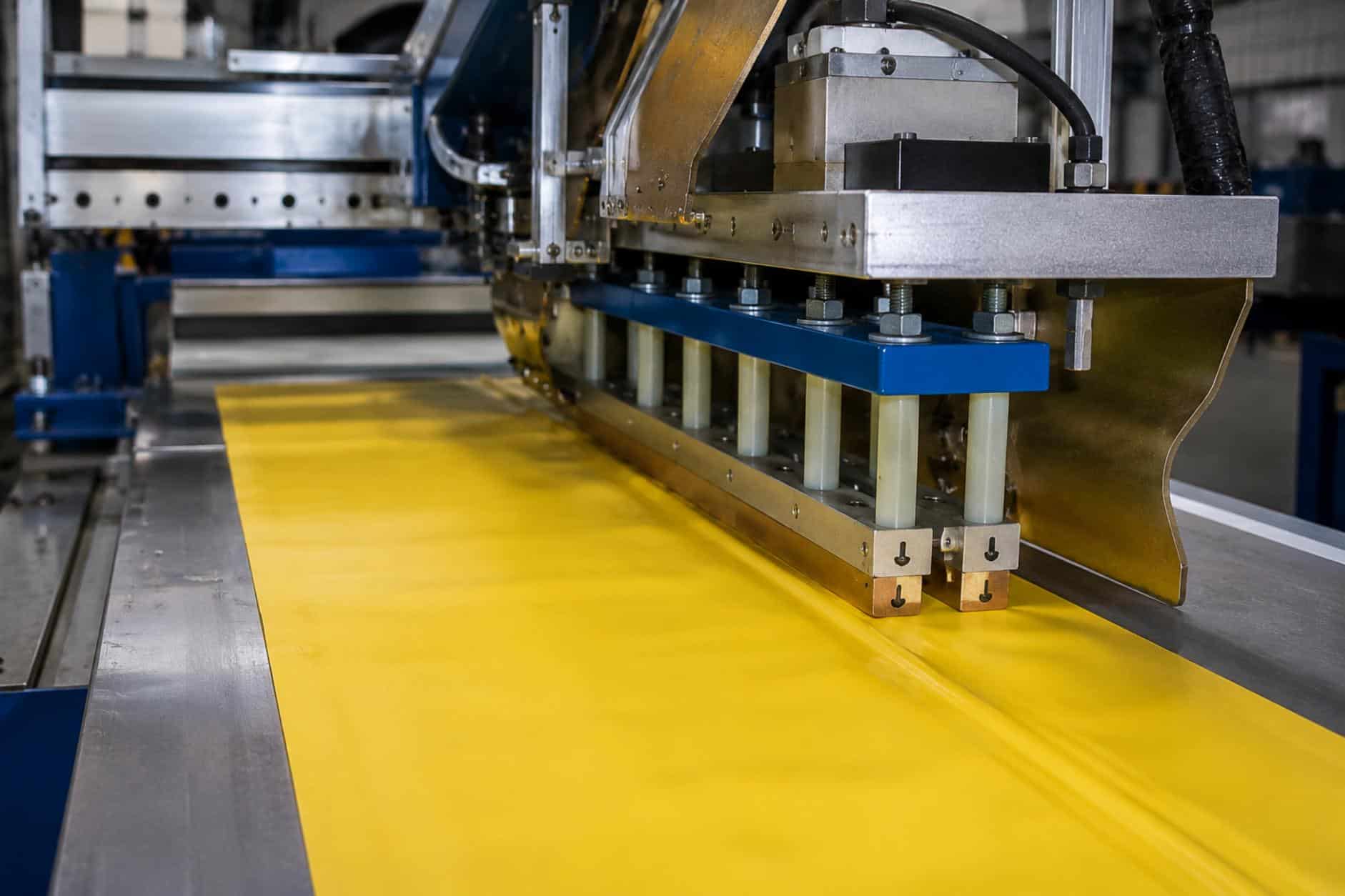
Table of Contents
- The Tolerance Problem in Aerospace Soft Goods
- What RF Welding Really Does
- How RF Welding Meets Aerospace Safety Standards
- Custom Fabrication Without the Tooling Nightmare
- Working With a Contract Manufacturer on Aerospace RF Welded Parts
- RF Welding With Vinyl Technology
- Key Takeaways
The Tolerance Problem in Aerospace Soft Goods
Aerospace programs live and die by their specs. A seam failure at 35,000 feet creates a very different kind of problem than one on the ground, and anyone who has worked on a flight program knows that distinction well. Soft goods rarely receive the manufacturing attention their safety responsibility demands. Protective covers, inflatable bladders, cushioning systems, ducting assemblies & containment bags all carry significant consequences if they fail. These components, through custom RF welding, must hold pressure, survive temperature cycling, resist fluid exposure, and withstand years of repeated handling on the flight line.
RF welding has become one of the more reliable methods for producing this category of parts, and we think engineering and procurement teams who specify soft goods for flight and ground support programs owe it to their projects to take a close look at what this process can do.
Start a Project Request A Quote
What RF Welding Really Does
RF welding, also called dielectric welding, uses high-frequency electromagnetic energy to fuse thermoplastic materials at the molecular level. No stitching, no adhesive, no mechanical fastener. The two material surfaces essentially become one, and the resulting bond often exceeds the tear strength of the base material. For aerospace applications, that translates into very practical outcomes: airtight seams, reliable fluid containment, and pressure integrity across a wide range of operating conditions.
The most commonly used materials for aerospace RF welding are PVC, urethane-coated fabrics, and TPU. Each of these responds well to the dielectric process and offers properties that suit the demands of flight and ground support environments. TPU, in particular, has gained traction in aerospace soft goods due to its flexibility across temperature ranges and resistance to hydraulic fluids and fuels.
One of the more underappreciated advantages here is weight. RF-welded seams add no hardware, no grommets along a seam line, and no extra layers of reinforcement tape to compensate for stitch perforations. On a program where the weight of every component gets scrutinized, a fabrication method that produces a strong, clean bond without adding bulk deserves serious consideration from your design team.
How RF Welding Meets Aerospace Safety Standards
Aerospace components face a genuinely punishing set of conditions: vibration, pressure cycling, UV exposure, hydraulic fluid contact, and temperature swings that can run from well below freezing to well above ambient. A fabricated soft good has to perform reliably across all of those conditions, not only the ones that show up in the easy test cases.
Radio frequency welding holds up here for a specific reason. The weld parameters (frequency, pressure and dwell time) get dialed in during the development process and documented. Every production weld runs to the same settings, which means the process is repeatable and traceable in a way that hand sewing cannot match. Stitched seams introduce a row of needle perforations through the material. Each of those perforations is a potential leak path, and under pressure cycling or fluid exposure, those paths can open. RF welded seams carry no perforations at all.
From a qualification standpoint, a manufacturer with RF welding and RF sealing capability can support leak testing, burst pressure testing, and peel strength validation directly from the production process. The documented weld parameters give your quality team a reference point for every part in the run. Procurement teams, this is the point in the conversation where the questions tend to get more specific, and that’s exactly the right response. The more specific the question, the better the resulting part.
Custom RF Welding Component Fabrication Without the Tooling Nightmare
Low-volume, high-specification work is exactly where RF welding earns its keep. Aerospace programs frequently need small runs of highly engineered soft goods, and that profile aligns well with RF welding’s strengths.
Hard tooling requirements are minimal. Custom weld dies come together quickly and at a fraction of the cost of injection mold tooling or vacuum forming equipment. For a program that needs ten units of a protective bladder to support a qualification campaign, that cost difference is significant. NRE costs remain low, and your engineering team can still revise the design without scrapping a five-figure mold.
Turnaround from drawing to first article can run in days or weeks rather than months, which aerospace programs on compressed schedules tend to appreciate. The iteration cycle is short enough that design changes between prototype and production stay manageable. For programs managing tight budgets and tighter schedules, that flexibility has real dollar value. The fabrication process scales to the program’s actual needs rather than requiring the program to scale around the process.
Working With a Contract Manufacturer on Aerospace RF Welded Parts
Working with a contract RF welding manufacturer on aerospace soft goods typically starts with a drawing or a physical sample. From there, the manufacturer develops the die, runs a prototype, and works through any fit or performance issues before moving to production. The process is straightforward, and a good manufacturing partner keeps the weld parameters on file so that repeat orders come out consistent with the first article.
When your procurement team vets a potential RF welding partner, a few questions cut to the heart of whether they can actually support an aerospace program. Ask about material certifications for the specific thermoplastics in your design. Ask how they document their quality control process and whether they have experience specifically with pressure-bearing or fluid-containment applications. Those two application types carry more risk than a simple cover or sleeve, and experience with them tells you a lot.
Domestic soft goods manufacturing offers real advantages for aerospace work: supply chain visibility, faster back-and-forth during development, and an audit process that doesn’t require coordinating across time zones or dealing with international shipping delays.
RF Welding With Vinyl Technology
At Vinyl Technology, we’ve spent years manufacturing custom RF welded components for aerospace programs and other industries where a part failure carries real consequences. We work directly with engineering and procurement teams, not through distributors, not from a catalog. Every custom RF welded component we produce is built to order from your drawings, samples, or specs.
We don’t do off-the-shelf. Our whole operation is set up around custom fabrication, which means your application gets the weld parameters, material selection, and quality documentation it actually needs rather than something close enough.
Reach out to our team with what you have. If your program needs inflatable bladders, protective covers, ducting assemblies, containment bags, or other precision soft goods, let’s talk about what we can build for you.
Start a Project Request A Quote
Key Takeaways
- RF welding fuses thermoplastic materials at the molecular level, producing bonds that frequently exceed the tear strength of the base material
- Aerospace soft goods carry real safety responsibility and deserve the same manufacturing scrutiny as hard components
- Weld parameters are documented and repeatable, giving quality teams a traceable reference point across every part in a production run
- RF welded seams introduce zero needle perforations, eliminating a common leak path that stitched seams create
- Custom weld dies cost a fraction of injection mold tooling, which keeps NRE costs low and makes design iteration practical
- Domestic contract manufacturers offer supply chain visibility, faster development communication, and simpler auditing

Article Reviewed For Accuracy By: Jackie Sanchez, VP of Sales Operations
Jackie Sanchez is the VP of Sales Operations at Vinyl Technology.
Jackie became a VP in 2021 following over four years of service as our Director of Human Resources. Her leadership competencies include human resources capacity, ethical conduct, strategic thinking, decision making, and financial management.
She holds an undergraduate degree from Chapman University. Follow her on LinkedIn.